
In 2026, customer service will not be remembered for how many interactions it can handle, but for how well it handles them.
At a time when customers expect immediate, personalized, and consistent responses across every channel, the real game-changer is real-time intelligent support for the people who interact with customers every day.
This is where a new role emerges: the augmented agent. An operator who no longer works alone but is assisted by AI systems capable of analyzing context, intent, and emotions while the conversation is still ongoing, turning every interaction into a high-value decision-making moment.
The new frontier of Customer Service
In recent years, the adoption of AI in contact centers has grown rapidly, evolving from simple chatbots and basic automation to AI systems integrated into every component of the customer-company interaction.
By 2025, according to multiple industry reports, a significant share of organizations had already implemented or tested AI solutions in their customer service processes, achieving over 80% effectiveness in support functions and decision assistance for agents and managers.
In practice, many companies no longer used AI just to answer FAQs or route simple requests; AI had become an integral part of the customer engagement value chain, capable of extracting insights, anticipating needs, and optimizing complex tasks.
Market reports predicted that AI technology in contact centers would grow to over $7–12 billion by 2030, with strong year-over-year acceleration.
However, the real transformation emerging in 2026 goes beyond merely using AI tools. We are witnessing a structural transition toward augmented agents: human operators supported in real time by contextual AI systems that provide suggestions, data, and decisions while the conversation with the customer is still ongoing.
By 2025, AI was already seen as essential for improving efficiency and productivity in customer service teams:
- Many companies had adopted AI to handle at least part of interactions, using tools that could reduce average handling time, improve customer satisfaction, and provide automated support outside business hours.
- Conversational AI and chatbots were widely used as the first touchpoint, deflecting a significant volume of requests and relieving human agents to focus on more complex tasks.
- Many organizations considered AI not only a support technology but a strategic lever to create more personal and engaging experiences, with algorithms segmenting in real time and adapting the customer journey.
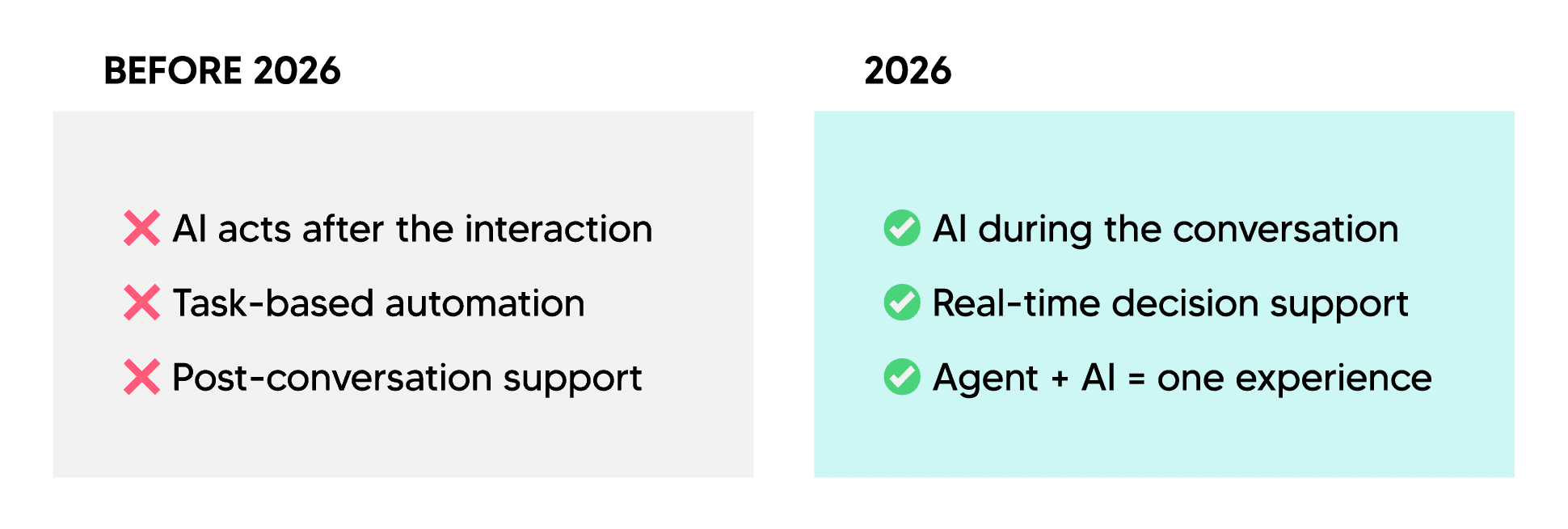
Yet, technology was often reactive, intervening mainly after the customer interaction had started or to automate specific tasks, rather than enhancing the human agent while the conversation was still happening.
2026: AI as a live Partner
In 2026, we are entering a new phase: AI is no longer an external tool but becomes an integral part of the process, with an active, “live” role within interactions. Contact centers are evolving into structures where:
- Human agents are no longer alone. They receive dynamic suggestions, contextual information, customer history, and possible next steps during the conversation, not afterward.
- Human-machine synergy becomes the norm, not the exception, focusing on enhancing the quality of each interaction.
- The line between virtual assistant and human agent blurs, with AI acting as a cognitive co-pilot, increasing the agent’s decision-making and relational abilities.
The transition to augmented agents involves a true cultural and operational shift:
- Organizations must rethink workflows, decision-making processes, and performance metrics, considering how to measure quality, empathy, and perceived value in AI-enhanced human interactions.
- Teams must prepare to manage new professional profiles, where communication skills, empathy, and the ability to collaborate with AI become core competencies.
- Governance of data, security, and compliance must be redefined to ensure real-time AI operates transparently, reliably, and ethically.
In this sense, 2026 represents an evolutionary shift from autonomous technology solutions to integrated human + AI ecosystems, where every decision, suggestion, and optimization happens in the moment of the customer interaction, without compromising speed or experience.
What is an augmented agent and why it matters in 2026
In 2026, what makes a difference in customer service is the quality of the decision made during the interaction.
The augmented agent becomes a critical asset: a human operator empowered by real-time AI tools that transform every customer contact into an effective, consistent, and personalized experience.
Real-time decision support
The defining feature of the augmented agent is the AI’s ability to provide active suggestions during the conversation. The technology interprets in real time:
- customer emotions and tone, detecting frustration, dissatisfaction, or enthusiasm;
- implicit intent and emerging needs, even if not clearly expressed;
- complete customer history, including interactions across all channels.
AI combines this information and suggests the most effective response or the optimal next step.
This means the agent is not making blind decisions but is guided by intelligent data that increases the likelihood of first contact resolution.
Instant contextualization
Previously, agents spent precious minutes searching for information in the CRM, consulting notes, or extracting data from company systems. The augmented agent eliminates this obstacle through automatic contextualization:
- dynamic summaries of the ongoing interaction;
- highlighting critical information from multiple systems;
- suggestions on scripts, policies, or procedures to follow.
The result is that the agent can focus on human dialogue and customer relationships, without wasting time on manual research. Studies show this approach reduces average handling time by 30–40% compared to teams without AI support.
Predicting next steps
Another key capability is predictive insight, AI analyzes historical patterns, behaviors of similar customers, and real-time data to suggest the next best action, whether offering a product, activating a service, or escalating a case.
This allows agents to anticipate customer needs, transforming the conversation into a guided path toward optimal resolution.
Impact on work and the market
Adoption of augmented agents is radically changing how contact centers operate, benefiting both agents and companies. With real-time AI, agents become faster and more precise: response times drop, and handled requests increase without compromising service quality. At the same time, response personalization improves significantly, making every interaction more effective and increasing customer satisfaction.
Another key effect is on cognitive load: agents no longer need to remember every detail or manually search across systems, reducing stress and burnout, and allowing focus on higher-value tasks.
For companies, the strategic impact is significant. Research shows that by 2026, over 60% of enterprise contact centers will adopt real-time AI to empower agents, raising customer experience standards and creating a tangible competitive advantage. Integration of technology and human intelligence not only improves operational efficiency but also redefines the parameters of service quality, transforming how businesses engage with customers.
Enabling technologies for the augmented agent
Behind every augmented agent is a suite of advanced technologies working together to transform the customer interaction in real time. Even non-technical users can understand the impact, as each tool simplifies the agent’s work and makes service more effective.
- Natural Language Understanding (NLU) & Natural Language Generation (NLG): these technologies enable AI to understand human language and formulate natural responses, almost as an experienced colleague would. NLU deciphers customer intentions and needs, while NLG helps the agent communicate clearly, consistently, and contextually, without having to manually read complex notes or manuals.
- Real-time Sentiment Analysis: the system reads the customer’s tone, emotions, and mood during the conversation. This way, the agent immediately knows if the customer is frustrated, confused, or satisfied, and can adapt their language, pace, and proposed solutions. It’s like having an “emotional thermometer” that guides the interaction.
- Predictive Analytics: AI predicts possible next steps based on historical data and the behavior patterns of similar customers. For example, if a customer often has problems with a certain type of order or service, the system suggests the most effective solution even before the problem fully emerges.
- Contextual CRM Data Analysis: the agent receives all relevant information in seconds, supplemented by CRM systems and previous interactions. No more searching through files and databases: the customer’s context is at their fingertips, ready to be used in the conversation.
These technologies work together to put the agent in the best possible position, combining the speed and accuracy of data with human empathy and judgment. The result is faster, more accurate, and above all, more satisfying interactions for the customer, without requiring advanced technical skills from the operator.
XCALLY and the augmented agent
The augmented agent model cannot exist without a solid technological foundation, capable of analyzing, interpreting, and supporting the interaction while it is happening. In XCALLY, artificial intelligence is not an optional layer, but a structural component of the customer experience platform.
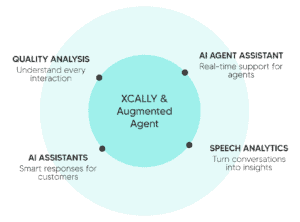
The AI features integrated into XCALLY work on two main levels: quality analysis and active support for the agent, transforming every conversation into a source of immediate and measurable value.
Quality Analysis to truly understand what happens in conversations
One of the foundations of the augmented agent is the ability to read and interpret interactions objectively. XCALLY integrates advanced Quality Analysis tools that allow going beyond the simple recording of calls.
- Automatic transcription
XCALLY automatically converts voice recordings into text, recognizing different accents and languages. The Split Voice Recording feature allows separating the agent’s voice from the customer’s, making it possible to conduct a detailed analysis of each single intervention. This simplifies data extraction, conversation review, and large-scale qualitative analysis. - In-call Sentiment Analysis
During the call, the system monitors the emotional flow of the conversation, classifying sentiment as positive, neutral, mixed, or negative. This allows understanding not only what is said but how it is perceived, providing immediate insight into the customer’s satisfaction level. - Post-call analytics
After the call, XCALLY analyzes the emotional tone of both the customer and the agent. Voice tone detection allows identifying recurring trends, critical issues, and improvement opportunities, providing a clear view of customer service performance over time. - QA categories
Conversations can be automatically categorized using keywords, key phrases, and sentiment. This allows quickly identifying critical situations, such as escalations due to negative sentiment or frequent interruptions, and intervening in a targeted way in quality and training processes.
AI Assistants for intelligent and contextual responses for customers
XCALLY’s AI Assistants are designed to provide highly specific and contextual responses, based on customers’ actual requests. These are not generic automations, but intelligent assistants that understand intent and deliver information consistent with the interaction context.
This allows to:
- speed up the resolution of the most common requests;
- reduce the load on human agents;
- maintain consistency and quality in responses across all digital channels.
AI Agent Assistants to enhance the operator’s work
AI Agent Assistants represent the heart of the augmented agent, providing intelligent support to the agent while the conversation with the customer is still ongoing. These tools do not merely suggest responses: they provide guidance on next steps, priorities, and possible escalations, integrating in real time information from the CRM and other company systems, eliminating the need for manual research and reducing the risk of errors.
For multilingual or global contexts, AI Agent Assistants can be further enhanced by the XCALLY Real-time Translator, that allows managing interactions in different languages without interrupting the conversation flow. The system automatically transcribes the customer’s words into the agent’s language, provides the translation of the agent’s response, and plays it back to the customer, ensuring smooth and natural communication. For text interactions, translation happens in real time on chat, SMS, WhatsApp, and other digital channels.
In this way, the human agent remains the true protagonist of the customer relationship but works alongside a cognitive co-pilot that accelerates decision-making, improves response quality, and enables a more empathetic, consistent, and personalized customer experience, even in complex or multilingual scenarios.
Speech Analytics to transform conversations into strategic insights
A key element of the augmented agent is the ability to transform every interaction into data useful for immediate and strategic decisions. In XCALLY, this function is handled by Speech Analytics, an AI-driven solution that automatically analyzes voice and digital conversations, allowing companies to move from a reactive approach to a truly data-driven one.
Thanks to Speech Analytics, companies can:
- proactively identify at-risk customers, advanced sentiment and behavior analysis allows detecting signals of dissatisfaction or churn, triggering targeted interventions before they become concrete problems;
- reduce Average Handling Time (AHT): by providing agents with real-time suggestions and insights, conversations become faster and more focused without sacrificing quality or personalization;
- eliminate unproductive silences, the system highlights unnecessary pauses or inactivity, making interactions more dynamic, fluid, and focused on conversation goals.
- optimize team costs, QA automation, smart coaching, and performance monitoring reduce the need for manual checks, lower training and turnover costs, and allow agents to focus on higher-value tasks;
- increase conversion rates by understanding customer needs, intentions, and behaviors in real time, agents can seize more opportunities, close more sales, or offer additional services more effectively;
- filter inefficient or low-impact interactions, the system highlights conversations that do not generate immediate value, allowing the team to focus on strategic interactions where the contribution of the agent and AI truly makes a difference.
In short, Speech Analytics is not just a monitoring tool: it is a true accelerator of service quality, integrating real-time insights and post-call analysis to turn every interaction into an opportunity for learning, operational improvement, and customer loyalty.
The augmented agent as the new normal
In 2026, customer service becomes smarter, more human, and more effective. Augmented agents represent the present: they are operators working side by side with real-time AI, capable of delivering superior and lasting customer experiences.
If customer service is the heart of a relationship with the customer, in 2026 its efficiency will depend on the quality of the interaction, enhanced by real-time AI, and not just the technology itself.
Find out how XCALLY can transform your contact center into an environment where advanced technology and attention to people together create extraordinary results.