

“Real-time agent assist” is one of those expressions that appears in almost every conversation about AI in customer service.
It appears in vendor presentations, strategic roadmaps, AI discussions, and board-level conversations about efficiency and automation. But behind the buzzword, there is often confusion.
Is it just another chatbot? Is it post-call analytics with a new name? Is it full automation? Not exactly.
To understand why real-time agent assist is becoming central to customer experience in 2026, we need to strip it down to its essentials.
The simple idea: AI that helps during the conversation
Real-time agent assist means that while an agent is speaking with a customer on chat or voice, AI is working in the background to help.
It’s not about stepping in after the call, nor about waiting for a report or dashboard to be reviewed the next day. The support happens exactly at the moment decisions are being made, while the conversation with the customer is still ongoing, providing the agent with immediate, contextual guidance.
The system listens (or reads), understands the context, and suggests relevant answers, retrieves information, or recommends the next best action.
From the customer’s perspective, nothing looks different. They simply experience faster and more accurate service.
From the agent’s perspective, everything changes. Think of it as a smart co-pilot that reduces uncertainty and speeds up decision-making.
Why traditional support models no longer scale
Customer service environments are more complex than ever. Knowledge bases are constantly expanding, making it harder for agents to find the right information quickly. Products evolve rapidly, and company policies change frequently, requiring agents to stay up to date at all times. At the same time, the volume of customer interactions continues to grow across multiple channels, adding pressure to respond accurately and efficiently.
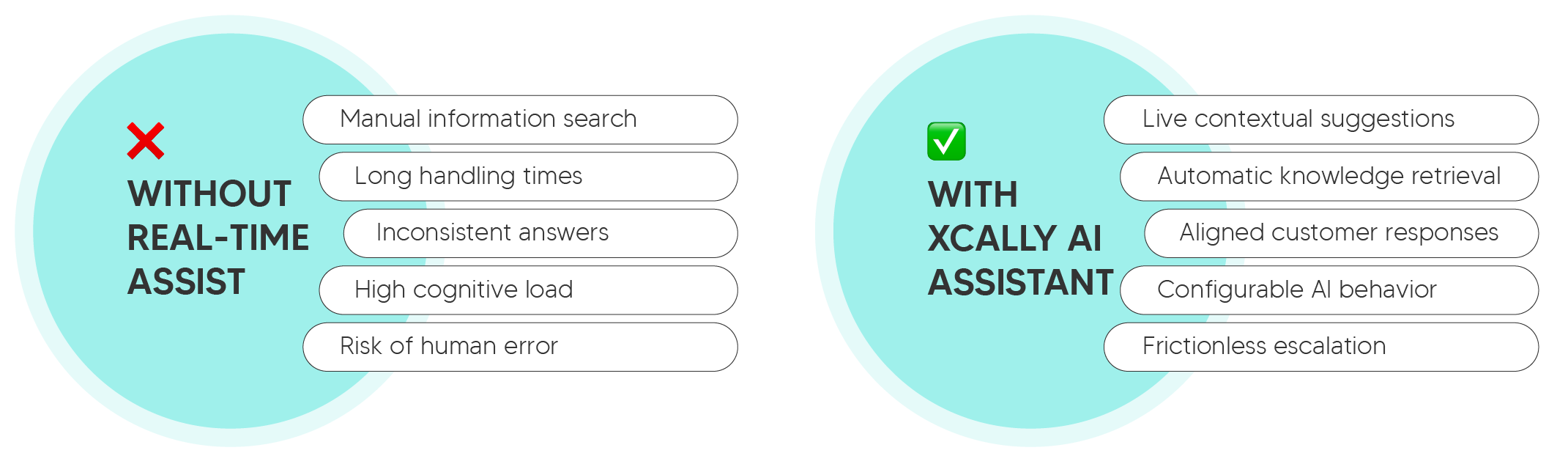
Agents are expected to remember details, navigate multiple systems, and respond confidently in real time. This increases cognitive load and introduces risk: inconsistent answers, longer handling times, unnecessary escalations.
This is where real-time agent assist becomes operationally relevant. Instead of forcing agents to search manually across tools and documents, the system surfaces relevant information automatically based on what the customer is saying.
What’s happening behind the scenes
Under the hood, real-time agent assist relies on a combination of natural language processing (NLP), large language models (LLMs), contextual data retrieval, integration with knowledge bases and enterprise systems and low-latency processing.
As the customer speaks or writes, the AI model processes the input, interprets intent, and maps it against available knowledge sources.
If your documentation includes refund policies, product manuals, or service guidelines, the system can reference those materials instantly. In more advanced configurations, the assistant does not rely on static scripted flows. Instead, it uses structured instructions and connected business documents to generate contextual responses dynamically.
Latency is critical. If suggestions arrive too late, they lose operational value. For this reason, real-time agent assist systems are designed to operate within strict response-time thresholds so they can influence the ongoing interaction.
This is what differentiates true real-time assist from simple analytics or reporting tools.
How XCALLY enables real-time agent assist
Within XCALLY AI Solutions, real-time agent assist is embedded directly into the interaction flow.
Organizations can configure OpenAI Assistants inside XCALLY, define behavioral instructions, and upload business documents that the assistant can use as knowledge sources. These files, such as PDFs, manuals, or internal procedures, become part of the assistant’s contextual understanding.
When a customer asks about a specific issue, the assistant retrieves relevant information from those documents and provides accurate, contextual suggestions.
Everything is configurable:
- assistant name and model selection
- response instructions and tone
- escalation phrases for human handover
- welcome and exit messages
- token usage monitoring
Assistants can be integrated into chatbots and voicebots, ensuring consistency across digital and voice channels. And when the situation requires it, the conversation can be seamlessly redirected to a human agent, without breaking the customer journey.
The result is structured, controllable AI support aligned with your operational processes.
Controlled AI, not uncontrolled automation
One common concern among CX leaders is loss of control. With XCALLY, assistants are configurable and governed. You define:
- how the assistant should behave
- what it should say when it does not know the answer
- when to escalate to a human agent
- which knowledge sources it can access
If necessary, the system can automatically route the interaction to a queue and forward the customer to a human operator, maintaining continuity without friction.
Additionally, token usage can be monitored, enabling cost control and visibility over AI consumption.
This makes real-time agent assist not only intelligent, but manageable at an enterprise level.
From automation to augmentation
There’s often a misconception that AI is designed to replace agents. Real-time agent assist follows a different philosophy: augmentation. Agents remain in control. They decide how to use the suggestions. AI reduces cognitive load, accelerates information retrieval, and ensures alignment with official knowledge sources. This is particularly valuable in high-volume environments where even small efficiency gains can generate significant operational impact.
Better guidance leads to faster resolutions. Faster resolutions improve customer satisfaction. Higher satisfaction strengthens loyalty.
Why this matters now
In 2026, customer experience is no longer defined only by friendliness or availability. It is defined by precision and responsiveness.
Customers expect immediate clarity. Agents need tools that keep pace with growing complexity. Organizations require scalable systems that maintain consistency.
Real-time agent assist is becoming a foundational layer of modern customer service because it connects intelligence directly to action.
When implemented within a unified environment like XCALLY, it becomes part of a broader omnichannel strategy integrating AI, automation, knowledge management, and human expertise into a single operational ecosystem.
And that is what makes the difference between experimenting with AI and operationalizing it.