

Most people have interacted with an IVR system at least once, even if they did not know the name.
When you call a company and hear a recorded voice saying “Press 1 for sales, press 2 for support”, you are interacting with an IVR, or Interactive Voice Response system.
IVR is a technology that allows organizations to automatically manage incoming phone calls by guiding customers through a menu of options. Instead of immediately speaking to an operator, the caller can navigate through a series of prompts that help identify the reason for the call.
Behind the scenes, the system collects the caller’s input and routes the interaction to the appropriate department, service, or automated process.
For companies handling large volumes of calls, IVR systems play a critical role in organizing communication flows and reducing pressure on human agents.
How IVR systems work
At its core, an IVR system follows a structured workflow designed to guide the caller through a decision tree.
The process typically includes several steps.
First, when a customer calls the company, the IVR answers automatically and plays a welcome message. This message usually introduces the available options, such as technical support, billing, or order tracking.
Next, the system waits for the customer to respond. Traditionally, responses are provided through the telephone keypad, a technology known as DTMF (Dual-Tone Multi-Frequency). For example, pressing “1” may direct the caller to the sales department, while pressing “2” might connect them to customer support.
Once the caller selects an option, the system executes a predefined action. This could mean transferring the call to a specific queue, playing additional information, or triggering an automated process such as checking an account status.
More advanced IVR systems can also retrieve customer data by integrating with CRM platforms or internal databases. This allows the system to personalize the experience or provide contextual routing.
The ultimate goal is simple: help customers reach the right solution as quickly as possible while minimizing unnecessary transfers and waiting times.

Why IVR is essential for modern customer service
Customer service teams today manage significantly higher call volumes than in the past, while customers expect faster and more accurate responses.
Without automation, every call would require immediate human intervention, which would quickly overwhelm support teams.
IVR systems help organizations address this challenge by:
- reducing wait times, directing callers to the correct department immediately;
- automating repetitive requests, such as balance inquiries or appointment confirmations;
- improving call routing accuracy, ensuring customers reach the right specialist faster;
- optimizing agent workloads, allowing human agents to focus on complex interactions.
For industries such as healthcare, banking, e-commerce, and telecommunications, IVR has become a foundational component of the customer communication infrastructure.
However, traditional IVR systems have also faced criticism for being rigid or difficult to navigate.
This is where artificial intelligence begins to redefine the experience.
How AI is transforming IVR systems
Artificial intelligence is changing the way IVR systems interact with customers.
Traditional IVR systems rely on static menus and predefined choices. Customers must listen to options and select a number that best matches their request.
AI-powered IVR systems, on the other hand, can interpret natural language. Instead of pressing numbers, customers can simply say what they need.
For example, a caller might say: “I want to check the status of my order.”
The AI system processes the request, identifies the intent, and routes the call or retrieves the information automatically.
This approach significantly improves usability and reduces friction during the interaction.
AI also introduces several advanced capabilities, including:
- speech recognition to understand spoken requests;
- natural language processing (NLP) to interpret intent;
- context awareness based on customer history and data integration;
- intelligent call routing that adapts dynamically to the situation.
The result is an IVR experience that feels less like navigating a machine and more like having a conversation.
The importance of flexibility in IVR design
While IVR technology is powerful, its effectiveness depends heavily on how the system is designed.
Poorly structured menus can frustrate customers and increase call abandonment rates. On the other hand, well-designed call flows can significantly improve efficiency and satisfaction.
For customer service teams, this means IVR systems must be easy to configure, adapt, and optimize.
In many traditional platforms, modifying an IVR flow requires technical skills or direct intervention from IT teams. This slows down innovation and makes it harder for businesses to adjust workflows when processes change.
Modern platforms aim to solve this problem by providing visual tools that simplify IVR configuration.
How XCALLY simplifies IVR configuration with
drag-and-drop design
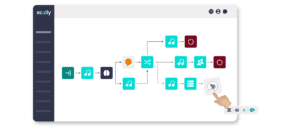
XCALLY offers a visual IVR designer that allows organizations to create and modify call flows using a drag-and-drop interface.
Instead of writing complex scripts or code, administrators can build IVR workflows by visually connecting functional blocks that represent different actions.
Each block represents a specific step in the interaction, such as:
- playing a welcome message;
- collecting user input;
- routing calls to a queue;
- connecting to an agent;
- retrieving information from external systems.
By dragging and linking these elements together, teams can design sophisticated call flows quickly and intuitively.
This visual approach makes IVR configuration accessible not only to technical teams but also to operations managers and CX specialists.
The advantages of XCALLY’s drag-and-drop IVR builder
The drag-and-drop architecture provides several operational benefits.
- Faster implementation
New IVR flows can be created or modified in minutes rather than days, allowing companies to respond quickly to operational needs.
- Greater flexibility
Businesses can easily update menus, routing logic, or automation steps as processes evolve.
- Improved collaboration
Because the interface is visual and intuitive, different teams can participate in designing the customer journey.
- Reduced dependency on developers
Customer service teams gain greater autonomy when managing communication workflows. - Better customer experience
By continuously refining call flows, organizations can reduce friction and ensure customers reach the right support path faster.
Key takeaways and opportunities
Voice interactions remain one of the most important communication channels.
The difference today is that voice systems are becoming smarter, more flexible, and increasingly integrated with AI technologies.
Modern IVR systems are no longer just automated menus. They are intelligent orchestration layers that connect customers, agents, and business systems.
With platforms like XCALLY, organizations can combine automation, AI-driven voice interactions, and visual workflow design to build scalable communication systems that improve efficiency without sacrificing the human touch.
And as AI capabilities continue to grow, IVR will play an even more strategic role in delivering fast, intuitive, and personalized voice experiences.